Sunday, March 30, 2014

Bacon

The kitchen is crowded and the pan is hot.
Everyone clattering, chopping, mixing,
Until the bacon, sizzling,
Calls us to a halt   
And brings us to our senses.

The sound and smell of cooking bacon is so evocative that even folks who do not eat meat begin to salivate, stirred by some deep sensory memory.  Called the ‘gateway’ food by vegetarians who find themselves reconsidering the diet of omnivores, bacon has that certain something that we all find irresistible.  Food scientists call that certain something the Maillard Reaction.  It occurs when simple sugars react with amino acids under heat.  It has to be high heat, at least 300 degrees, to get the reaction started.  Then meat on the grill, or in the sizzling frying pan, begins its chemical change.  The aroma expands and the food begins to brown and crisp, moving toward that magical stage when flavor becomes most intense.  
                                 
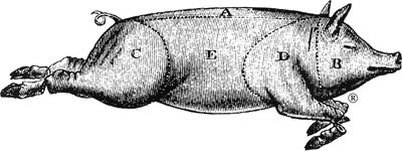
Now there is bacon, and there is life-changing bacon.  Such bacon begins with terrific pigs - pigs that have been pasture raised and get lots of sunshine and exercise, pigs whose diet is organic and varied, mostly green plants, fresh fruits and veggies.  And the meat from these excellent pigs will be processed into all the recognizable cuts of pork, ham from the hind leg and chops from along the ribs, etc.  And bacon.  Bacon, fortunately, can come from several areas.  Pork belly, with its substantial layer of fat, is the classic choice, but other cuts make beautiful bacon.


Here at Green Gate Farm we favor the part that is called hog jowls in the American South and guanciale in Italy.  Richly flavorful, the cheeks (or jowls) make superior bacon, having a perfect balance of tender flesh and fat.  Think of them as cheeky bacon - bacon with an attitude!  All of our Green Gate Farm bacon is ‘fresh’ bacon hand cut by an artisan butcher.  We have it packaged fresh, straight from pig to freezer, with no brining or smoking, no curing with chemical salts, and no injections of smoky flavored liquid additives.  This thick-cut bacon retains its meaty texture, cooks and crisps just the same as any bacon, and smells just as tantalizing.  And the seasoning of fresh bacon is up to you.  Sprinkle with salt, grind some pepper, or drizzle your bacon with real maple syrup as it cooks.    

The discovery of life-changing bacon is bound to transform your bacon and eggs at breakfast or your BLT at lunch.  But it can be so much more than realizing that you will never again be satisfied with overly salty, routine, wimpy bacon.  You will want to use it in as many ways as possible, and you will want to use every single scrap.  Be ready to save all the drippings and crumbly bits left in the pan.  Not so long ago, on the back of the stove in most kitchens, sat a container (usually an old coffee can) to collect the bacon drippings and keep them handy for use.  You don’t need an old can, just plan on using those drippings for your next meal.  Fix roasted vegetables, baked potatoes, sautéed kale or cabbage, even leftover take-out rice,  adding a spoonful or so of the precious drippings for a savory depth of flavor and that certain something that is bacon.  It will bring you to your senses.

For more about amazing bacon try these links:


Sunday, March 23, 2014

Who's Your Cook?

Americans, it seems, are crazy about the idea of cooking.  We have TV channels devoted entirely to food shows, we own designer cookware and shelves full of gorgeously photographed cookbooks (food porn).  We idolize hip young chefs as much as we revere old family recipes.  And while we watch or read about the preparation of some amazing dish, we are happily munching away on take-out broiled chicken or microwaveable pizza bites.  We love the idea of cooking, but we haven’t quite figured out how to include the activity of cooking in our daily lives.  We love the idea of cooking, but we embrace the reality of convenience.

A lot has been written about American’s decades-long love affair with convenience food.  Laura Shapiro, in Something from the Oven, chronicles how the prepared food industries gradually won over the hearts and minds (and tastebuds) of American families.  In Salt, Sugar, Fat Michael Moss explores the complicated relationship between the technology of developing prepared foods and the science of consumer marketing which convinces us that we really must have these products to make our lives better. 

Gradually more and more of the selection of recipes, the preparation, and the cooking of America’s food  took place in industrial kitchens, and the skills of many home cooks began to devolve into ‘just heat and eat.’  A farmer friend, who for more than 20 years has sold meats and produce at his local farmstand,  says that it’s the folks between the ages of 30 and 60 who just don’t seem to know much about cooking.  Those generations, the late Boomers, Gen Xers, and Millennials, are clueless about most cuts of meat and puzzled that different kinds of potatoes or apples have different uses.

It’s no surprise really.  Most of us grew up in a world where home cooked meals involved taking something out of a package and following the directions on the back.  Cooking from scratch seemed a kind of alchemy from another age, full of mysterious practices: mincing, filleting, sautéing, braising, reducing, deglazing.  Julia Child may have finessed these skills for us in her television studio kitchen, but except for special holiday meals, they were not a part of the average American family’s supper preparations.

There are some hopeful signs that the supremacy of convenience foods may be waning.  Sales of fresh food have increased, up 5.4% according to a recent article in Business Week.  Organic food sales, according to the USDA, show an even greater increase, up 11%.  Farmers markets are booming and the numbers just keep climbing.  So somebody out there must be in the kitchen at the ready with well sharpened knives, extra virgin olive oil, and a good heavy-bottomed sauté pan.  Bon appetit! 


Sunday, March 16, 2014

Eating is an Agricultural Act

Whatever morsel you are putting in your mouth, whether packaged ramen noodles or organic sweet potato, powdered ‘lemonade’ drink or yogurt smoothie, you are eating from the farm.  Granted the foodstuffs may be processed, amended and altered beyond recognition, but the raw materials are plants, or from animals that eat plants.  Everything we incorporate into our meals and our snacks, all  the good stuff and most of the bad stuff, was once upon a time truly ‘farm fresh.’

‘Eating,’ proposes farmer, writer, and environmental legend Wendell Berry’ is an agricultural act.’ The relationship of humans to farming is basic. Wherever you live and work, though it may be far removed from any landscape resembling a farm, you are as tied to agriculture as any dairyman, market gardener, or Midwestern corn grower. Choosing what we eat is at the heart of Berry’s concept of the ‘agricultural act.’  Farmers raise what consumers choose, and our preferences determine what it is profitable to grow.

We may choose to eat what is familiar, convenient, or affordable.  We often choose the tempting - the salty, starchy, fatty, and sweet foods we seem hardwired to crave.  In the U.S. our choices probably are determined by what we find attractive on the supermarket shelves, or listed on the menu marquee of a fast food restaurant.  The food industry has been more than happy to cater to our desires, especially for products that are quick and convenient to get on the table. For a long time now, it seems, many of us have made our selections about what to eat based pretty much on the enticing full color photographs on the boxes of microwaveable meals.  

But American consumers are changing, and we are increasingly choosing food that looks and tastes like what it is, food straight from the farm.  We are discovering that the pleasures of eating are not limited to the faculty of taste.  We seek out foods that are organic and locally grown.  We show a preference for foods that are fresh and high in nutrition.  We are trying out foods that probably never graced our childhood plates, kale? edemame? chorizo? and we take these fresh foods into the kitchen and experiment with how to cook them.  Then we recommit ourselves to the agricultural act when at last we sit down to eat.

When writing about agriculture and the food industry in his essay The Pleasures of Eating, Wendell Berry reminds us that through our choices in the marketplace, we, the consumers, are driving the agricultural machine.  The foods we value and place in high demand are the foods that producers will scramble to provide.  We are the motivators and the moderators of our agricultural system.  Chew on that.

For more from teacher, poet, novelist, and essayist Wendell Berry, you might begin with Bringing It to the Table: On Farming and Food or It All Turns on Affection: The Jefferson Lecture and Other Essays.  

Or follow these links:
http://billmoyers.com/episode/full-show-wendell-berry-poet-prophet/


                                     Photo of Wendell Berry thanks to www.neh.gov


Saturday, March 8, 2014

Wineberries


How is it that here in West Virginia, with snow still on the ground, we’re in our shirtsleeves and searching for berries?  The brambly thicket behind the greenhouse has needed attention since last autumn when the biomass had diminished enough to see what was really growing in there.  To be honest, it has needed attention since last spring, when it seemed that one day everything was just starting to green up and the next it was burgeoning into a verdant mass worthy of a painting by Jean Jacques Rousseau.  But today, a rare winter day of blue skies and mild breezes, is really the perfect day to find the wineberries.

On our place and the surrounding acres there are several patches of bramble fruits - black raspberries, blackberries and wineberries.  They stretch along old fence lines and tumbled fieldstone walls, and spread into the dappled light under medium growth hackberries, poplars, black walnuts and pignuts (a sort of hickory).  Most are out in the far fields, away from the activities near house and barn, and so are frequented by all the wild berry pickers.  Deer and raccoons, rabbits and possums, field mice and all the wild birds from titmouse to crow, love the berry buffet.

But the thicket we are tackling grew up around a section of old board fence, the boundary between the farm buildings and an area of open woodland known as ‘the chicken woods.’  It has been protected a bit by its proximity to buildings busy with humans, barn cats and farm dogs.  In berry season it is shaded during the hottest part of the day, and after a rain it catches a bit of additional runoff from nearby roofs.  It is the perfect spot for a wineberry patch.  
  
We wade into the tangle with loppers and saw, removing ancient gnarled grapevines and wiry greenbrier.  Most of the multiflora rose (a rampant invasive species around here) is ousted, though we leave a few selected canes to grow and bloom and perfume the first warm nights of summer.  What we are most carefully avoiding are the fiercely bristling red canes of the wineberries.  Their arches are long, eight or nine feet, and covered in insidiously fine thorns. Though we are in our shirtsleeves, we are also outfitted with thick leather gloves. We probably should be wearing face protectors too.


Like other brambles, wineberries are perennials, with new fruit coming on last year’s canes.  The problem is, we didn’t tackle the thicket last year to cut back the canes that had finished fruiting.  So we have to leave as many as we can if we hope to see fruit this summer.  We’re trying to make up for our year of neglect, clearing away the strangling vines and the competition of the small maple and locust trees  that have  already made some headway under the shelter of the thicket.  On this unwintry day we’re braving the thicket and thorns. We’re trying to give this special patch every advantage, so come June there will be wineberries for cobblers and tarts, wineberries for sauces and jams, and wineberries to eat by the handful standing in the summer sun.    


Image thanks to Somers Pioneer History

Saturday, March 1, 2014

Farm Bill

Last month the 2014 Farm Bill passed both House and Senate.  After lengthy bipartisan wrangling, our legislators finally signed on to a bill which might just begin to take food production in the US in some new directions.  Since we are consumers and taxpayers, as well as farmers, we’re trying to gauge what to expect from this legislation.

Farm bills are reviewed, revised and reauthorized about every five years.  A farm bill as defined by the USDA is a ‘large-scale reauthorization of diverse Federal agriculture and food programs.’  The first farm bill, a product of the depression, addressed two of the gravest issues of the time.  It gave direct help to struggling farmers and set up a system which sought to ensure that the nation could maintain an adequate food supply.
                                  

This newest farm bill, the Agriculture Act of 2014, projects spending of about $956 billion over the next ten years, and it covers a whole lot of territory.  Its many provisions will affect the future of conservation and energy, price supports, crop insurance and risk management, organic and sustainable agriculture, farmers markets, food labeling, school lunches, local and regional food systems, rural development, urban farming and much more.   

Sorting out what this farm bill is expected to accomplish is daunting.  There are so many factions, so much debate.  The news media in all its diversity, from The Washington Post to Ag Week, from heritage.org to the Huffington Post, have weighed in on various aspects of the bill.  But there seems to be general agreement as to the two major issues addressed by the 2014 version. The first is how farmers, from small family farms to large corporate agribusinesses, can expect the federal system to support the risky business of raising and selling food.  The second, almost overwhelming in its scope, is nutrition.  For more than a decade the bulk of any farm bill’s funding is steered toward programs intended to protect public health and nutrition. That is true of this year’s bill, but it is also the area of the bill to suffer significant cuts. 

So now that the Farm Bill is law will the appropriated funding be enough to support so many and such far reaching programs?  We’ve got to hope that as a country we can ‘put your money where your mouth is.’  Will funding be adequate to help keep farmers on the farm and keep agricultural land available for continued food production? Will it truly support small farm enterprises and programs to help new farmers enter the field?

Will funding allow the expansion of current organic and sustainable agriculture programs, and support the development of local food marketplaces?  Most of all, despite the cut-backs in the supplemental nutrition program, will funding ensure that all Americans, wherever they live and whatever their income, have access to the best of nutrition -- foods fresh from America’s farms?  

Interesting and useful links for keeping an eye on how the 2014 Farm Bill is doing:

FarmPolicy.com                                                            http://farmpolicy.com

Rural Advancement Foundation International               http://rafiusa.org

Farm Aid                                                                      http://www.farmaid.orgT

The Equation - Union of Concerned Scientists             http://www.ucsusa.org


National Sustainable Agriculture Coalition                 http://sustainableagriculture.net/

Image thanks to Agrarian Nation                             http://agrariannation.blogspot.com


Sunday, February 16, 2014

Poor Man's Fertilizer


Snow, over the boot tops snow, ensures a quiet day for most of us. And in between snowshoe treks out to check on the animals in the barn, or to sweep the accumulated white stuff off the greenhouse, it is a quiet day at Green Gate Farm. With the wood stove cranked up and the kettle on the boil it is the perfect time to sit and think about gardens.  


The seeds we ordered a while back are already here, and the field plans are spread out over the big farm table.  While the snow is falling and the fire is crackling, our ideas for this season's gardens begin to take shape, and with them comes the growing anticipation of getting back outside and getting down to work.

The snow, however, is already at work in the garden.  Truly a blanket, snow is a terrific insulator, holding the surface temperature of the soil a bit above freezing and reducing the temperature fluctuations that are so hard on overwintering plants. Deep snow like this will melt at a fairly slow rate, allowing the soil to hang on to more moisture.  Moisture from rain and especially slow-melting snow is a significant source of nitrogen in healthy soil. 

'Poor man's fertilizer' the old timers used to call a late winter snow, since nitrogen, along with phosphorus and potassium, is one of the three essential macrobiotics which fertilizers provide.  This slow melt allows nitrogen mineralization, which is a fancy name for how nitrogen is converted by soil microbes into a form plants can use. 

Linger awhile, snow, do your work in the garden incrementally, even microscopically.  We'll be out there soon enough, working with spade and hoe, turning the benefits of a white winter into a garden green with summer vegetables.  


Friday, February 14, 2014

PASA - Farming for the Future


Folks wonder what farmers do in the winter time asking 'Do you get to slow down?'  Well, yes and no.  Farmers with livestock may not have to alter their routine all that much. Pigs, horses, cattle, etc. require a similar level of care in cold weather as when the pastures are green and lush.  At Green Gate Farm our pigs and layer flock are cozy in their winter quarters, but since we don't raise broiler chickens in the winter, there is a bit less outside work in that regard.

As produce growers, winter is a time of indoor work.  We inventory seed, design planting schedules and revamp greenhouse and field plans.  And of course, like all farmers, we try to play catch-up with the mountain of record keeping and paperwork that may . . . or may not . . . have been attended to over the busy growing season.  Yes, farmers are still busy during the winter, but the kind of work changes, and the pace is definitely slower.  So in the depths of snowy February, can farmers hope to take a break to recharge their batteries?  We can't speak for all the other farmers we know, but for Leslie and Lars PASA is the answer to that question.

Every February, PASA (Pennsylvania Association of Sustainable Agriculture) puts on a dynamite, energy-infused, information intensive, workshop-based conference called Farming for the Future.  Leslie and Lars have attended PASA together for the past two years, and Leslie has attended for several years prior.  Held at Penn State in State College PA, PASA offers a massive forum for growers in Pennsylvania and elsewhere to connect, share ideas and experiences, and attend workshops.  The dizzying array of topics includes biodynamic farming, encouraging earthworm populations in your soil, financial management for small farms, and Lars's favorite, draft horse power.


One needn't be a farmer to attend PASA, and there are scholarships to help folks interested in attending.  (Lars gratefully received a scholarship which funded his conference attendance.)  If you want to see what is happening in the Eat Local movement from the grower's perspective and have several days to explore the many ways in which we try to improve our businesses and practices, conferences like PASA's Farming for the Future is the perfect way.  To read more about what PASA is all about and learn more about future conferences, visit www.pasafarming.org.