Sunday, May 11, 2014

The Season of the Ramp

If you’re not having ramps for supper tonight, you’re probably not in West Virginia!


Here between the Blue Ridge Mountains and the Alleghenies late April and early May is the season for ramps.  This simple twin leaved member of the onion family creates a big stir this time of year.  Called wild garlic or wild leeks, Allium Tricoccum is an Appalachian delicacy.  Its garlicky odor is famously pungent, but its bright spring flavors are prized.  Cooked, the little bulbs taste sweet and oniony, while the leaves are like scallions or chives.

Like a fisherman who doesn’t care to share his favorite trout pool, or a morel hunter who keeps secret that special spot under the oaks, anyone who discovers a colony of ramps holds that knowledge very close, divulging the precise location to only a trusted few. 

Ramps require a very particular habitat, the moist rich soils of the Appalachian hardwood forests.  From Georgia all the way up through Maine, ramps can be found, usually at altitudes of at least 3,000 feet, though in colder climates it can be lower.  Where the environment is just right, ramps thrive and can spread into substantial colonies.

The trick with ramps is that the best environments tend to be the least accessible.  And the growing season is a brief four or five weeks.   So foraging for ramps requires dedication and timing.  Collecting ramps in the wild also calls for moderation.  Conservation groups urge foragers to take only 5 to 10 percent of the ramps in a colony.  The best rule of thumb may be to harvest only the largest ramps in a clump, since for the colony to remain vigorous most of the plants should be allowed to mature and go to seed.

For most of us, enjoying the culinary delights of ramps requires foraging at a local farmer’s market or seeking out one of the many regional ramps festivals.  But don’t delay, the season of the ramp is here!

More about ramps:
http://www.wildedible.com/wild-food-guide/ramps

http://wellpreserved.ca/preserving-spring-wild-leeks-or-ramps/

http://www.nytimes.com/2011/04/20/dining/20forage.html?pagewanted=all&_r=0

West Virginia Ramp Feasts and festivals:
http://wvexplorer.com/recreation/agritourism/ramp-feasts-festivals/

http://www.kingofstink.com/


Saturday, May 10, 2014

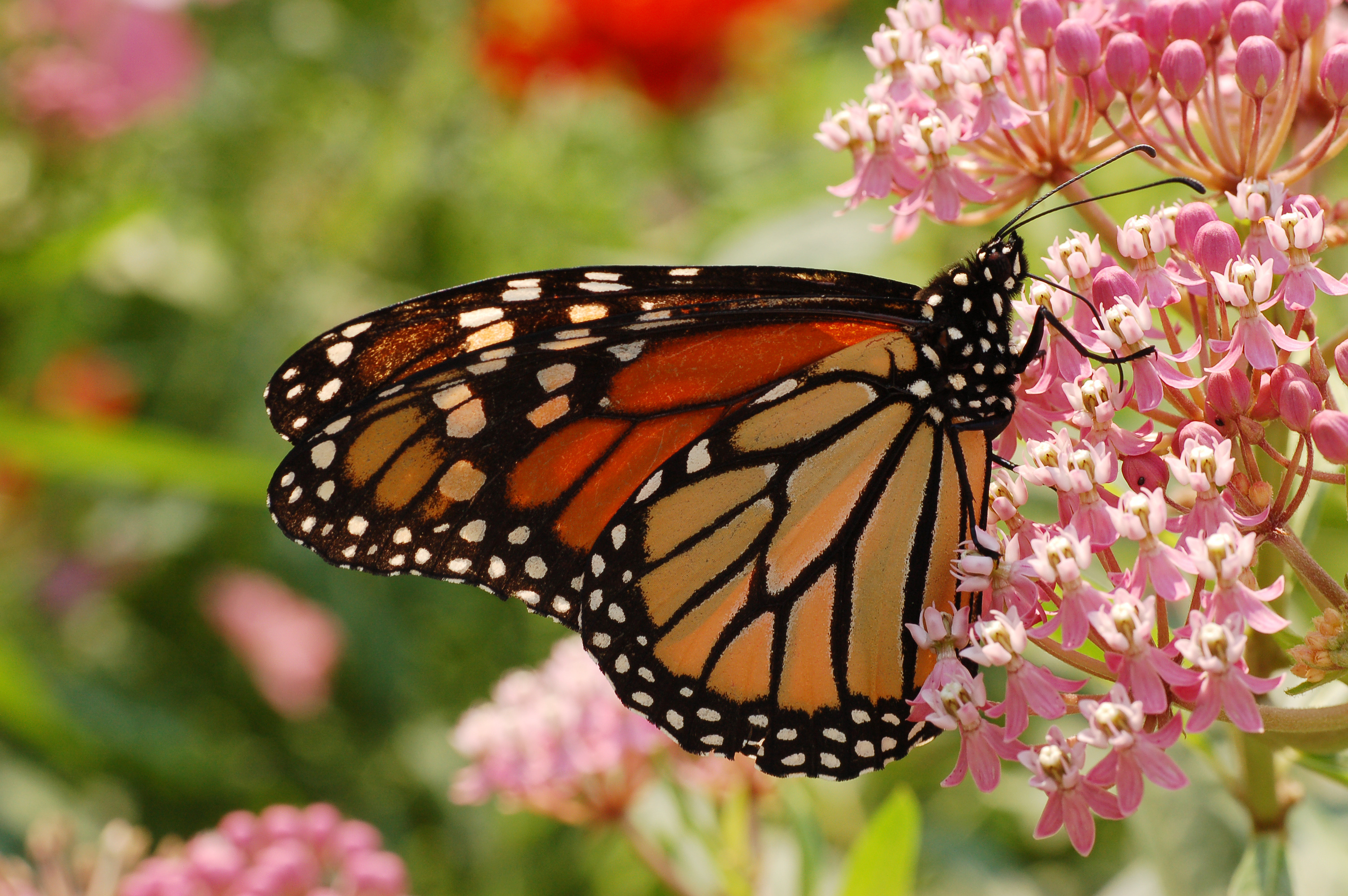
Monarch Butterflies - Orange and Black Signals Danger


The Monarch Butterfly, a species so widespread and beloved that it is the state insect of seven states, West Virginia, as well as Alabama, Idaho, Illinois, Minnesota, Texas and Vermont, is severely threatened.
   
Bear with me here.  Much of this post may remind you of your fourth grade science fair poster on the life cycle of butterflies.  Though the information may not be new, perhaps it will provide a little refresher course in the extraordinarily complex life of this lovely and fragile insect, and make clear why we all should be watching out for the Monarchs.

Adult butterflies live but a few weeks. Consuming only nectar from flowers, they search meadows, roadsides and gardens for the best sources.  Before they die, they seek out the proper food source for the next generation and lay their eggs on those plants. With luck, the caterpillars hatching from these eggs will emerge at just the right time, when the temperature and food supply are optimum. Caterpillars eat only leaves, each species favoring a common plant or tree of the region.  When cold weather comes, the caterpillars of most butterflies begin to change, becoming pupae which will live in a kind of state of suspended animation until they come forth as adults in the spring.
 
But what if the optimum environment begins to change? What if the temperatures become less predictable?  What if food sources disappear?   

One butterfly species, the familiar orange and black Monarch, faces all these challenges, partly because it has a very different strategy for survival.  This butterfly responds to the onset of cold weather by migrating.  Each October millions of Monarchs begin their trip south across the Eastern and Midwestern states following a very specific migratory pattern.   A smaller population on the west coast of North America travels a separate route down through southern California.  All are headed to Mexico, to a region high in the Sierra Madre Mountains.  There, the overwintering insects congregate in the Oyamel Fir forests.  They hang in great clusters, with perhaps 100,000 individuals per tree.  These colonies blanket the mountaintops, an extraordinary sight which has generated a steady tourist industry for the region.  In March, warmer weather triggers a reverse migration.  The Monarchs, in their millions, gradually drift up from the trees and head north, following the same routes traveled by countless previous generations.

These age old flight paths are based on where the necessary food sources will be found.  Monarch caterpillars can eat only plants from the milkweed family.  A wildflower, this tall, fuzzy-leafed plant with umbels of fragrant flowers is native throughout North America.  Common along roadsides and in fields, the plant self-sows easily.  Each plant produces a multitude of delicate seeds equipped with a silky tendrils which allow them to float far on the slightest breeze.  Hardy and adaptable, milkweed thrives in dry or wet conditions, at various latitudes and altitudes, and competes quite successfully with all the other plants in its vicinity.  It grows everywhere, providing a dependable food source for the Monarch  all along its migratory routes.

The Monarch’s very specialized reproduction pattern is attuned to its migratory habit.  The generation of overwintering Monarchs that leaves Mexico in March is called the first generation.  These butterflies fly north, and when attracted by a place with plenty of milkweed, stop to lay their eggs before they die.  The second generation matures and continues to migrate north, following the milkweed as it blooms.  Then the third generation caterpillars hatch, mature and head out for the milkweed buffet even further north.

In a single summer there may be as many as four generations heading steadily north, following the milkweed, all the way into southern Canada.  But at the end of summer, as the cold weather approaches, the final generation develops very differently.  Though these orange and black beauties look just like their parents and grandparents, the do not mate or develop eggs.  Their bodies become extremely efficient at converting and storing fat.  They’ll need it, because this is the generation that will make the entire return trip, 2,500 miles, all the way back to Mexico.

It is a complex and beautiful system for survival, one that has allowed the species to flourish even when a change in climate or habitat occured in some part of its expansive range.  But about 20 years ago scientists began to notice a significant disruption of the Monarch’s migrating patterns followed by an alarming decrease in its population.  It finally became evident that the problem was milkweed, or the lack of it.  The Monarch’s food source was disappearing.  Areas where once the plant was abundant were now free of all weeds, including the milkweed.

The fields and roadsides of America’s agricultural lands were now being chemically groomed to allow only specific crops to survive, and the agent was the herbicide Roundup.  Though Roundup had been around for a while, it was in the 1990s that crop plants were developed to be resistant to the effects of glysophate, the principal chemical in Roundup. ‘Roundup Ready’ corn, cotton, and soybeans were genetically modified to withstand the effects of the herbicide.  So a farmer could spray his fields and the chemical would eradicate all plants except the genetically modified crop plants.   It seemed a terrific tool for farmers to save time and labor and better ensure good crop survival.  But every year millions of acres received the treatment, eradicating milkweed all along the Monarch’s migration routes.

In 2013-2014 the Monarch population has reached a new low of 30 million butterflies, half of the number recorded for 2012-2013, and a drastic decline from the long term average of 350 million.  Scientists estimate the population by determining the total area, in hectares, covered by the overwintering colonies.  This number is then multiplied by the number of individuals typically found clustered in a hectare.   Last winter the overwintering population covered less than 1 hectare (about 2.5 aces) compared to over 20 hectares a scant twenty years ago.

Severe weather across North America in recent decades has certainly been a factor in the Monarch’s struggles.  Deforestation of habitat in Mexico has also played a part.  Scientific teams and environmental groups have long been working to preserve the areas in Mexico where Monarchs gather.  But it is the lack of food throughout the entire migration route that has caused the Monarchs’ numbers to plunge to dangerous levels.  The only way to limit the Monarch Butterfly's decline is to return milkweed to its habitat.


Below are links to connect you with information about how we all can help.  Consider participating in one of the citizen scientist programs and help collect important data on Monarch migration. Or find out about conservation organizations which can get you set up to hand rear Monarch caterpillars until they can be released as adults. Learn out about legislation to restrict use of  glysophate along roadsides and highways or other non-agricultural lands.  Above all, plant milkweed!  Plant milkweed in masses if possible.  Anyone with a bit of yard, or even a balcony container garden, can encourage the growth of milkweed and begin watching out for the Monarchs.        

Find out more about Monarchs:


Monday, April 14, 2014

Which came first . . . the chicken tractor or the egg-mobile?

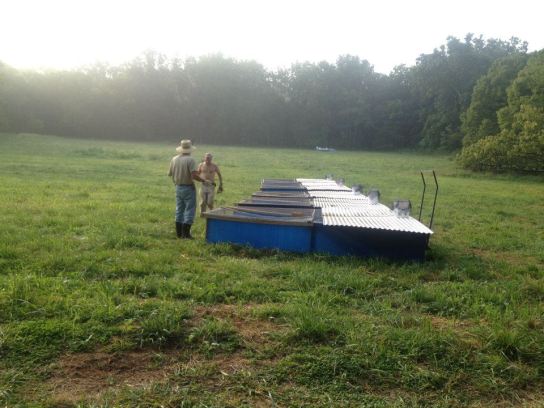
Chicken tractor?  A mobile chicken house, sometimes called a chicken tractor, can take various forms.  Our tractors for broiler chickens raised on pasture are low, broad chicken wire covered boxes.  They are roofed for protection from sun and rain, but the structure is very simple and lightweight, since the birds need to be moved onto new grass every day.  With the aid of a dolly just one person can slide this kind of hutch to a fresh patch of pasture, and the chickens, if they are in a cooperative mood, just trot along with their house.  The broiler chickens will be out on pasture in this shelter for about six weeks, until they have grown to weigh 3 to 5 pounds and are ready to be processed.

                                                   
Tractors for laying hens, however, must be much more permanent and well-furnished accommodations.
A layer tractor, or egg-mobile, is a coop on wheels.  Lars and Leslie built our egg-mobile on an old silage wagon which makes it large enough for a flock of 100 birds.  Imagine a peak-roofed gypsy wagon all fitted out with nesting boxes, waterers and roosts.
This egg-mobile needn’t be moved as frequently since a generous section of pasture around the wagon is safely enclosed by electric poultry fence.  The ladies descend from their roost each morning, eager to get outside onto the dewy grass and get down to the business of foraging.  Chickens are omnivorous, thriving on a diet of grains, fresh fruits and vegetables, and for protein – the choicest worms, beetles and grubs on offer in the pasture. In addition, laying hens need access to calcium.  We offer chicken ‘grit’, crushed limestone or oyster shells, to help with digestion and to provide the birds with the extra calcium they need to produce sturdy eggshells.

  When it is time for the hens to be on fresh pasture the whole assemblage, wagon and fencing, is moved to a new area.  Why go to all the trouble of raising chickens in what seems to be an elaborate and labor intensive way?  Because a fresh egg from a pastured chicken is such a marvel.

Strong eggshells, requiring a decisive crack to open, are your first clue that your eggs are from active, well-fed pastured hens.  The contents of a fresh egg should slide out as a unit and spread out very little on contact with the pan.  Here’s a beautiful example:
The yolk is large, high and rounded, and is a vivid dark yellow or orange.  That lovely color comes only from pastured chickens which are out in the sunlight consuming lots of green plants and insects.  The albumen of a fresh eggs is cohesive, thick and translucent, sometimes described as opalescent.  Also often noticeable in fresh eggs are the two little white twists, the chalazae, which attach the yolk to the egg membrane. And of course, the lively flavor of a fresh egg from a small farm pastured flock is unsurpassed.  

It's a marvel of engineering, this compact little package of Omega 3s, beta carotenes, and Vitamin E all wrapped up in lovely shades of brown, blue, green or white.  Beautiful in an Easter basket, beautiful on a Passover Seder plate, beautiful any way you fix them, if your eggs didn't start out in an egg-mobile, the yolks on you!
                                               

                    The many colored eggs of our mixed breed hens in a traditional Heirloom Egg Basket by Anne Bowers.


Sunday, April 6, 2014

Got GMOs?

Is your food non-GMO?  That’s one of the first questions a farmers market customer or potential CSA member is likely to ask. For farms like ours, based on organic principles, the answer is easy - no GMOs.  But the reasons we avoid GMOs and the reasons people are concerned enough about them to ask are more complex.   

GMOs, genetically modified organisms, have become a very big factor in American industrial farming, and their continued use sparks vigorous debate.  In the scientific community, as well as among the public, there seems to be very little middle ground.  GMOs are perceived as either a grave danger to the environment and sustainable agriculture, or a gratefully-received solution to the challenge of feeding everyone on the planet.   

Hunger is a very real issue in our world, and the growing global population continues to put more and more pressure on our resources. That we must create strategies for future adequate food production is crucial.  It has always been so.  From the very beginnings of civilization, one of the principle concerns of a society, surely the primary task of a society, has been to ensure a steady supply of food.  There were many strategies – migrating to areas with better resources, domesticating animals for food and work, and learning to cultivate desirable food plants.  People have always bent their minds and their backs to the challenges of finding, growing, storing and improving food.

Today, we are even more compelled to find ways to increase food production.  It might even be considered an ethical imperative that agricultural experts should constantly seek ways to improve disease and pest resistance, increase tolerance to extremes of climate, and extend growing seasons.  If our society is able to develop the expertise and the technology to solve these problems, why question their use?  Why be worried about GMO foods?

GMOs are created by fundamentally altering the DNA of an animal or plant, thus engineering a radical and almost immediate development of specific desired traits, traits which help the organism compete and flourish.  Setting aside the issue of whether or not we should be tinkering with one of the most intimate parts of any organism, its genes, there are other ethical considerations at stake. 

Surprisingly, the least debated aspect of the issue is whether GMO foods can be safe and nutritious for humans to eat.  Many medical and scientific groups, including the American Medical Association, the World Health Organization, and the Union for Concerned Scientists have concluded that the safety risks to ingesting GMO food seem minimal.  But all also acknowledge that there are a great many unknowns about the impact of GMOs in our food system.  The real debate centers on those unknowns.

Consumers are concerned about transparency in food production and the proper labeling of food containing GMOs.  Scientists fear the side effects of altering plants so that they are toxic to insect pests.  How might beneficial insects be affected, and in what ways might the altered genetic material travel up the food chain?  Many experts also fear that engineered genes may wind up being transferred to other food crops or to native plants, causing unintended and problematic modifications.  Some of the biggest GMO news stories of the past five years concern the inadvertent emergence of plants containing engineered genes among nearby traditional non-GMO crops.


This brings up the hottest topic in the GMO debate - the ownership of engineered genes.  GMO seeds and the engineered genes themselves are patented and forever owned by the agritech corporations which develop them.  High tech GMO seeds come with a higher price tag than conventional seeds.  And farmers who plant these patented GMO seeds must sign a contract promising that they will not save and reuse any seeds, an economical practice farmers have always depended upon.  How can smaller farms hope to compete when big agribusiness controls the market?  How can the smaller economies of developing nations hope to achieve food security when the monopoly which controls global agriculture, fiercely protecting its intellectual properties as well as its profit margins, determines who will have access to its products and how its technologies are to be implemented? 

Consider this: almost 70% of the world’s seed development and sales is controlled by only ten companies.  All are actively invested in creating and promoting GMOs.  In the U.S., the biotech giants Monsanto, Cargill, and DuPont lead the pack, with Monsanto alone accounting for nearly 25% of the global seed market.   In 2013, about half of U.S. cropland, 169 million acres, was planted in GMO crops, and forty percent of those crops were engineered in Monsanto’s laboratories.  If we are looking to GMO technology to improve global food supplies, then we have put our faith in a handful of private corporate entities and their shareholders.  It is pretty clear who is controlling our food supply.  

Try these links to learn various points of view about GMOs and the future of our food supply:

http://www.ucsusa.org/food_and_agriculture/our-failing-food-system/genetic-engineering/risks-of-genetic-engineering.html


Sunday, March 30, 2014

Bacon

The kitchen is crowded and the pan is hot.
Everyone clattering, chopping, mixing,
Until the bacon, sizzling,
Calls us to a halt   
And brings us to our senses.

The sound and smell of cooking bacon is so evocative that even folks who do not eat meat begin to salivate, stirred by some deep sensory memory.  Called the ‘gateway’ food by vegetarians who find themselves reconsidering the diet of omnivores, bacon has that certain something that we all find irresistible.  Food scientists call that certain something the Maillard Reaction.  It occurs when simple sugars react with amino acids under heat.  It has to be high heat, at least 300 degrees, to get the reaction started.  Then meat on the grill, or in the sizzling frying pan, begins its chemical change.  The aroma expands and the food begins to brown and crisp, moving toward that magical stage when flavor becomes most intense.  
                                 
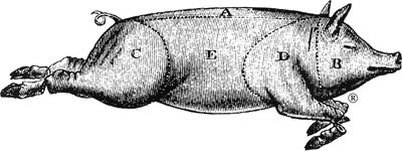
Now there is bacon, and there is life-changing bacon.  Such bacon begins with terrific pigs - pigs that have been pasture raised and get lots of sunshine and exercise, pigs whose diet is organic and varied, mostly green plants, fresh fruits and veggies.  And the meat from these excellent pigs will be processed into all the recognizable cuts of pork, ham from the hind leg and chops from along the ribs, etc.  And bacon.  Bacon, fortunately, can come from several areas.  Pork belly, with its substantial layer of fat, is the classic choice, but other cuts make beautiful bacon.


Here at Green Gate Farm we favor the part that is called hog jowls in the American South and guanciale in Italy.  Richly flavorful, the cheeks (or jowls) make superior bacon, having a perfect balance of tender flesh and fat.  Think of them as cheeky bacon - bacon with an attitude!  All of our Green Gate Farm bacon is ‘fresh’ bacon hand cut by an artisan butcher.  We have it packaged fresh, straight from pig to freezer, with no brining or smoking, no curing with chemical salts, and no injections of smoky flavored liquid additives.  This thick-cut bacon retains its meaty texture, cooks and crisps just the same as any bacon, and smells just as tantalizing.  And the seasoning of fresh bacon is up to you.  Sprinkle with salt, grind some pepper, or drizzle your bacon with real maple syrup as it cooks.    

The discovery of life-changing bacon is bound to transform your bacon and eggs at breakfast or your BLT at lunch.  But it can be so much more than realizing that you will never again be satisfied with overly salty, routine, wimpy bacon.  You will want to use it in as many ways as possible, and you will want to use every single scrap.  Be ready to save all the drippings and crumbly bits left in the pan.  Not so long ago, on the back of the stove in most kitchens, sat a container (usually an old coffee can) to collect the bacon drippings and keep them handy for use.  You don’t need an old can, just plan on using those drippings for your next meal.  Fix roasted vegetables, baked potatoes, sautéed kale or cabbage, even leftover take-out rice,  adding a spoonful or so of the precious drippings for a savory depth of flavor and that certain something that is bacon.  It will bring you to your senses.

For more about amazing bacon try these links:


Sunday, March 23, 2014

Who's Your Cook?

Americans, it seems, are crazy about the idea of cooking.  We have TV channels devoted entirely to food shows, we own designer cookware and shelves full of gorgeously photographed cookbooks (food porn).  We idolize hip young chefs as much as we revere old family recipes.  And while we watch or read about the preparation of some amazing dish, we are happily munching away on take-out broiled chicken or microwaveable pizza bites.  We love the idea of cooking, but we haven’t quite figured out how to include the activity of cooking in our daily lives.  We love the idea of cooking, but we embrace the reality of convenience.

A lot has been written about American’s decades-long love affair with convenience food.  Laura Shapiro, in Something from the Oven, chronicles how the prepared food industries gradually won over the hearts and minds (and tastebuds) of American families.  In Salt, Sugar, Fat Michael Moss explores the complicated relationship between the technology of developing prepared foods and the science of consumer marketing which convinces us that we really must have these products to make our lives better. 

Gradually more and more of the selection of recipes, the preparation, and the cooking of America’s food  took place in industrial kitchens, and the skills of many home cooks began to devolve into ‘just heat and eat.’  A farmer friend, who for more than 20 years has sold meats and produce at his local farmstand,  says that it’s the folks between the ages of 30 and 60 who just don’t seem to know much about cooking.  Those generations, the late Boomers, Gen Xers, and Millennials, are clueless about most cuts of meat and puzzled that different kinds of potatoes or apples have different uses.

It’s no surprise really.  Most of us grew up in a world where home cooked meals involved taking something out of a package and following the directions on the back.  Cooking from scratch seemed a kind of alchemy from another age, full of mysterious practices: mincing, filleting, sautéing, braising, reducing, deglazing.  Julia Child may have finessed these skills for us in her television studio kitchen, but except for special holiday meals, they were not a part of the average American family’s supper preparations.

There are some hopeful signs that the supremacy of convenience foods may be waning.  Sales of fresh food have increased, up 5.4% according to a recent article in Business Week.  Organic food sales, according to the USDA, show an even greater increase, up 11%.  Farmers markets are booming and the numbers just keep climbing.  So somebody out there must be in the kitchen at the ready with well sharpened knives, extra virgin olive oil, and a good heavy-bottomed sauté pan.  Bon appetit! 


Sunday, March 16, 2014

Eating is an Agricultural Act

Whatever morsel you are putting in your mouth, whether packaged ramen noodles or organic sweet potato, powdered ‘lemonade’ drink or yogurt smoothie, you are eating from the farm.  Granted the foodstuffs may be processed, amended and altered beyond recognition, but the raw materials are plants, or from animals that eat plants.  Everything we incorporate into our meals and our snacks, all  the good stuff and most of the bad stuff, was once upon a time truly ‘farm fresh.’

‘Eating,’ proposes farmer, writer, and environmental legend Wendell Berry’ is an agricultural act.’ The relationship of humans to farming is basic. Wherever you live and work, though it may be far removed from any landscape resembling a farm, you are as tied to agriculture as any dairyman, market gardener, or Midwestern corn grower. Choosing what we eat is at the heart of Berry’s concept of the ‘agricultural act.’  Farmers raise what consumers choose, and our preferences determine what it is profitable to grow.

We may choose to eat what is familiar, convenient, or affordable.  We often choose the tempting - the salty, starchy, fatty, and sweet foods we seem hardwired to crave.  In the U.S. our choices probably are determined by what we find attractive on the supermarket shelves, or listed on the menu marquee of a fast food restaurant.  The food industry has been more than happy to cater to our desires, especially for products that are quick and convenient to get on the table. For a long time now, it seems, many of us have made our selections about what to eat based pretty much on the enticing full color photographs on the boxes of microwaveable meals.  

But American consumers are changing, and we are increasingly choosing food that looks and tastes like what it is, food straight from the farm.  We are discovering that the pleasures of eating are not limited to the faculty of taste.  We seek out foods that are organic and locally grown.  We show a preference for foods that are fresh and high in nutrition.  We are trying out foods that probably never graced our childhood plates, kale? edemame? chorizo? and we take these fresh foods into the kitchen and experiment with how to cook them.  Then we recommit ourselves to the agricultural act when at last we sit down to eat.

When writing about agriculture and the food industry in his essay The Pleasures of Eating, Wendell Berry reminds us that through our choices in the marketplace, we, the consumers, are driving the agricultural machine.  The foods we value and place in high demand are the foods that producers will scramble to provide.  We are the motivators and the moderators of our agricultural system.  Chew on that.

For more from teacher, poet, novelist, and essayist Wendell Berry, you might begin with Bringing It to the Table: On Farming and Food or It All Turns on Affection: The Jefferson Lecture and Other Essays.  

Or follow these links:
http://billmoyers.com/episode/full-show-wendell-berry-poet-prophet/


                                     Photo of Wendell Berry thanks to www.neh.gov